Tag Archives: Myanmar

Luxury Around the World

Len Rutledge

Luxury and experiential travel are changing the travel industry and the way many people think about travel. While trips to see grandma will always occur, family trips today are often camping safaris through Africa or visits to remote lodges in Bhutan.

Today’s travellers are braver than ever and are prepared to travel well off the beaten track. They are looking for something unique and individual.  As new destinations emerge, traditional tourist hotspots and resorts have to rethink their approach in order to stay relevant.

I have just returned from Luxperience, an unmissable annual get-together for all those associated with the high-end travel industry. It was a meeting which exposed all the newest and best operators, and showed where this growing part of the industry is heading.

I have selected five products which show the level of luxury and diversity that is now available to world travellers. Any of them would be an experience of a lifetime for most people.

Deccan Odyssey

This is a luxury train in India comprising 21 luxuriously appointed coaches; 11 are to accommodate guests and the rest are used for different purposes such as dining, lounge, conference car and health spa. All the cabins of Deccan Odyssey are fully equipped with air-conditioning, internet connectivity, and personalized guest amenities that make sure that your journey is a comfortable and memorable one. There are two restaurant cars available which serve Indian, continental and oriental delicacies.

deccan

There are six itineraries which travel to a UNESCO World Heritage Site, an excellent vineyard, palatial residences, sun-kissed beaches, magical cities, and tranquil backwaters. All is done with the luxury and pomp that only India can muster. Truly, this is the journey of a lifetime.

Over the Top

This New Zealand helicopter company based in Queenstown provides more than just a helicopter ride. You can visit alpine glaciers and remote lakes, for hiking, boating, extreme golfing, winery visits, heliskiing or fly fishing. For guests wanting an interaction with some distinctive New Zealand characters, you can fly with eco-guides, chefs, artists – genuine New Zealanders who delight in making your stay a once in a lifetime experience.

over-the-top-golf-tee

One activity that is gaining in popularity is Over the Top Golf. This provides access to New Zealand’s most picturesque golf hole. Nestled at 4500 feet in the New Zealand alps this par 3 hole overlooking Queenstown has four tee boxes so you can attempt your hole in one. Players have to fly in, drive, chip and putt out on the top.

The Racha

This deluxe island hideaway in Thailand is set on a pristine beach on Racha Island 18 km south of Phuket. The resort features 85 luxurious villas and strives to be recognized as a leader in responsible and environmentally sustainable tourism. The island is known for its natural beauty and for its excellent corals and marine life. It is also a wonderful place for relaxation and for doing nothing.

lighthouse-pool

Many rooms have a large living area and a spacious private terrace. Each villa is superbly designed and features a luxurious bathroom and a rain-shower outside. The Earth Cafe is a contemporary chic international café serving Western and Thai food in air-conditioned comfort or on the terrace. Sunset Beach is a casual restaurant serving local specialties and snacks for lunch and fresh barbequed seafood and steaks for dinner right next to the beach. Firegrill is a fine dining restaurant offering Mediterranean cuisine.

R.M. Williams Tour

R.M.Williams was an Australian hero who did much to put the Australian Outback on the map. His famous boots became a symbol of toughness and style which continues to this day. The Tailor, in conjunction with R.M.Williams, has designed the ultimate tribute to RM Williams. In RM’s Footsteps is a 4-day journey which traces his personal history, telling the story of how he created the famous leather boots now sold around the world.

This amazing trip offers guests a rare opportunity to explore the legend of RM Williams by visiting several magnificent Outback destinations, such as the Flinders Ranges and Lake Eyre, enjoying traditional country hospitality and eating delicious regional cuisine. Guests travel in ultimate luxury aboard a Swiss-built Pilatus PC12 aircraft.

nilpena-station-with-the-flinders-ranges-behind

The trip begins in Adelaide with a private tour of the RM Williams workshop, factory, and museum, plus a chance to be fitted with your own boots, clothing and other bush apparel. You will receive a complimentary pair of Craftsman Boots. Another highlight is a visit to the historic Nilpena Station, a tour of the nearby red desert dunes, and a rare visit to the heritage listed Ediacara fossils made famous by the likes of Sir David Attenborough.

The Strand Cruise

On a languid journey along the Ayeyarwady River, the new luxurious Strand Cruise reveals the core of Burma in exceptional comfort. Cruise itineraries include 4 nights from Bagan to Mandalay and 3 nights from Mandalay to Bagan. While cruising you can clear your mind with a rejuvenating massage, or relax by the swimming pool. Enjoy the magnificent sunset from the upper deck while the sommelier delights you with a wide variety of wines. At dinner, the Chef will take you on a journey through refined cuisine.

slide-strand-cruise-b

Pampering and relaxation are the goals of the spa. You can heighten the experience with a massage in either an individual room or share the experience in our double room. The foot reflexology station will leave you ready to take on a new day of exploration and discoveries. The fitness room comes complete with treadmills, weights, and other gym equipment; everything needed for an invigorating workout.

Excursions allow you to explore the royal cities of Mingun, Amarapura, and Ava by horse-drawn cart; take in landmarks such as the U Bein bridge; and marvel at the enduring beauty of the country’s innumerable temples and monasteries.

Further information:

Deccan Odyssey: http://www.deccan-odyssey-india.com/

Over the Top: http://www.flynz.co.nz/

The Racha: http://www.theracha.com/new/index.htm

R.M.Williams Tour: http://www.thetailor.com.au/rmwilliams/

The Strand Cruise: http://www.thestrandcruise.com/

www.LenRutledge.com

Inspiring Inle Lake

Words: Len Rutledge   Pictures: Phensri Rutledge

Everyone visiting Inle Lake in Myanmar’s hilly north-east has an image in their mind of an Intha fisherman rowing with one leg at the stern of a flat-bottomed canoe, past a backdrop of mist-shrouded mountains. Fortunately most leave having seen their dream. With its stilted villages built over the water, ancient stupa complexes and a backdrop of green hills, Inle is the top attraction of Shan State and it has become one of Myanmar’s most visited tourist areas. There are flights from Yangon, Mandalay and Bagan to little Heho airport which at times seems overwhelmed by the volume of travellers.

Nyaung Shwe

This is the largest town near the lake but many visitors prefer to stay at one of the small hotels, guest houses or resorts around the lake. Even if you do this, don’t overlook the town. The busy Mingalar Market is in the northern part of the town and this sells a range of goods, mainly in the morning.

Inlay Lake893

A little way outside the town, is the teakwood Shwe Yawnghwe Monastery. The monastery has an ordination hall with unique oval windows and this has become a tourist attraction because of the opportunity to photograph young monks standing behind these.

Getting Around

Getting around

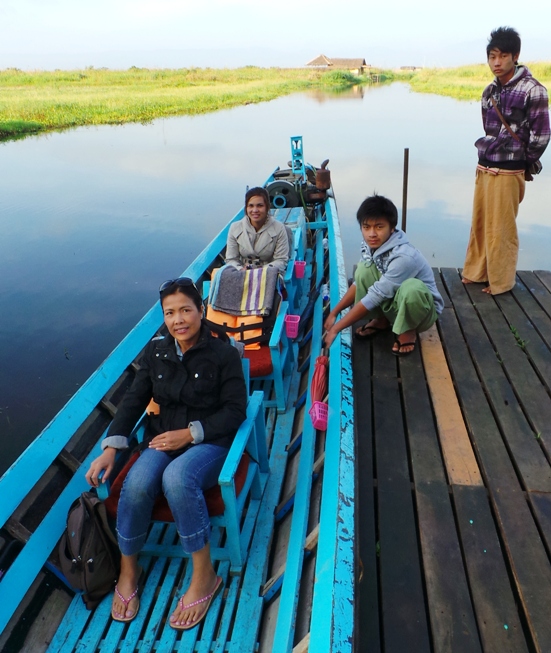
To reach most of the lakeside accommodation you need to transfer to a long-tail boat in Nyaung Shwe for a ride first down a wide canal, and then across Inle Lake itself. You will be pleased to find that the high-powered boats for tourists have padded seats, umbrellas and life jackets. The locals are not so lucky and we saw many boats that seemed well overloaded.

Floating gardens

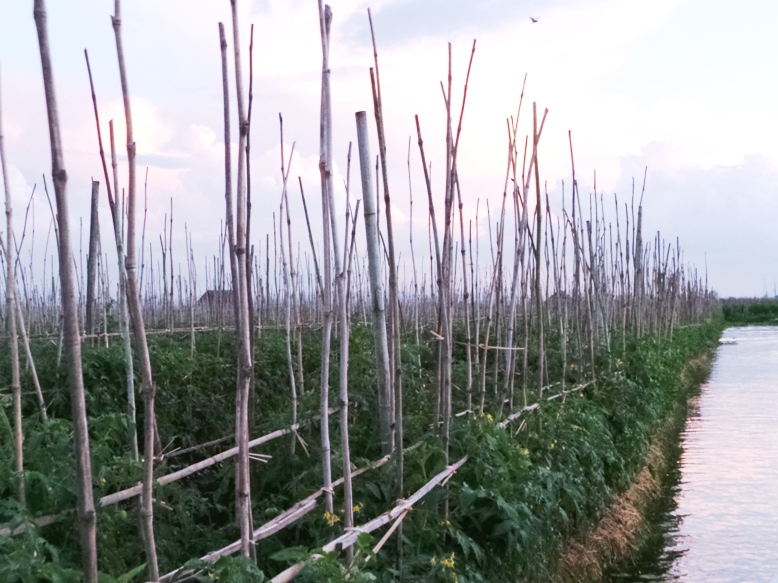
These are created by collecting weeds from the surface and lashing them together to form metre-thick floating strips. These are then anchored to the bed of the lake with bamboo poles, and heaped with mud scooped from the bottom. This means that they can be used regardless of fluctuating water levels. Crops – including cauliflower, tomatoes, cucumbers, cabbage, peas, beans and aubergine – are grown year-round.

Floating gardens

We’d seen some of the small wooden boats so piled up with weeds from the lake that they were sitting barely above the water and we’d seen groups of people in their boats working together to collect these weeds and now we knew why.

Phaung Daw Oo Pagoda

Phaung-Daw-Oo-Pagoda

The pagoda has been constructed in the traditional and elaborate Myanmar style of architecture even though it is over the water. At the centre of the monastery building is a golden stupa topped with an ornamental umbrella-shape. The interior walls of the temple are decorated with murals depicting Buddhist stories. In the central shrine in the main hall there are five small lumpy gold objects that were once recognised as Buddhas. Devotees have been placing so much gold leaf on them for so long, that the original forms are no longer recognizable.

One-leg rowers

One-leg rowers

The smooth lake, the blue sky, the small wooden boats with their huge basket nets, the rowers standing tall, leg and oar moving as one, make for a thrilling encounter. The rowers are men who stand in the stern of their boats with one leg wrapped around a single oar moving it steadily back and forth in an easy rhythmic practiced motion. Theories as to why this method of rowing evolved range from it providing both hands free for handling the fishing nets, to needing to stand to be able to see the reeds and weeds in the water ahead.

Local markets

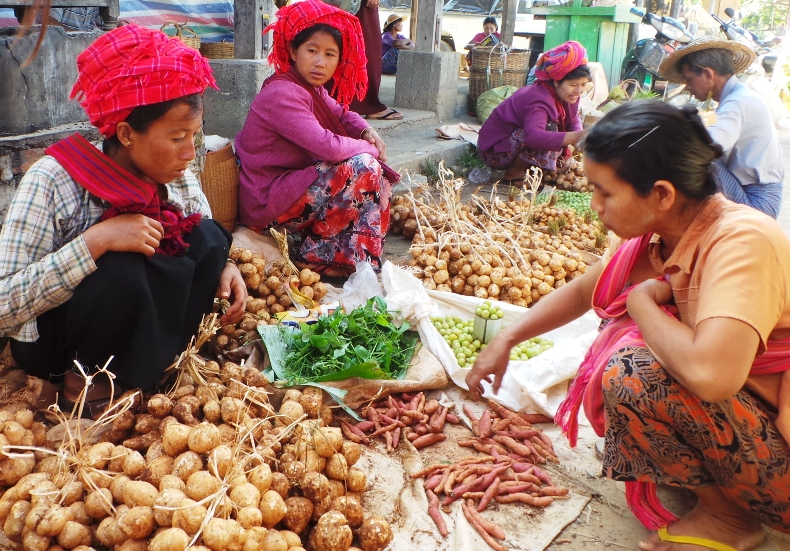
The markets in the Inle Lake area move each day from one of five locations to the next, ranging from Nyaung Shwe at the north end of the lake to Nam Pan towards the south end. Farmers come from all around to sell their produce, traders come to buy in bulk, and families come to do their regular household shopping. It is colourful and there is a strong sense of community but it rapidly gets crowded – mainly with tourists.

Market

One of the interesting aspects of the market is seeing women of the Pa-O ethnic group, the second most numerous tribe in the region. These women wear dark plain coloured skirts (lungyis) with long sleeveless shirts, cropped long-sleeved black jacketsand distinctive brightly coloured turbans.

Nga Hpe Chaung monastery

Nga Hpe Chaung monastery

It was built in the 1850’s on teak columns in the middle of the lake. It is a handsome building housing many beautiful Buddhist artifacts, and quite a few monks. Awhile back the head abbot and some of the monks trained several cats to jump through hoops, so it became known as the ‘jumping cat’ monastery to foreign backpackers. The trained cats are no more so you will just have to put up with the idyllic setting, its collection of old Buddhas from around Myanmar, and its peace and tranquillity.

In Dein

A narrow canal wound its way from the lake, initially through reed beds but later through dense jungle until finally the village emerged around a bend. It was a perfect rural scene with water buffaloes wallowing while women from the local village washed clothes nearby.

In Dein

We alighted at a small jetty and were immediately besieged by the locals who peddle their bamboo hats, “Welcome to Inle” T-shirts and Shan-style bags from little stalls. The highlight in town is a breathtaking complex of 1,094 16th century stupas, the main In Dein pagoda and the surrounding ruins which cover the dome of a hill. You reach here up a long roof-covered passage where there are hundreds of vendors. The top provides a sweeping view of the lake and surrounding farmlands.

Len Rutledge is the author of Experience Myanmar available as an e-book at http://www.amazon.com/dp/B00HPQHC5I

The delights of Yangon, Myanmar

Words: Len Rutledge   Pictures: Phensri Rutledge

Yangon, the largest city in Myanmar, is green and cool with lush tropical trees, shady parks and beautiful lakes. As it rapidly develops it has also acquired traffic problems, poverty and signs of international commerce. On first sight it is a typical Asian city, but you quickly realise that it is less modern than its Asian peers and it has its own calm culture.

The city right now feels like a frontier town in transition. The locals still dress in traditional longyi and only a small percentage own a mobile phone, yet shiny new apartment blocks are springing up between the peeling colonial facades, traffic jams have become common in some areas, and pizza and donut shops are appearing.

Yangon can be enjoyed by just walking its streets. The sights, smells and sounds will be strange to most visitors. You will see women with a yellow-white paste on their faces, vendors selling betel nut, and ancient buses and taxis blowing exhaust fumes over everything. The city, however, does have its ‘not-to-be-missed’ attractions and here are some suggestions.

Shwedagon Pagoda

Shwedagon Pagoda

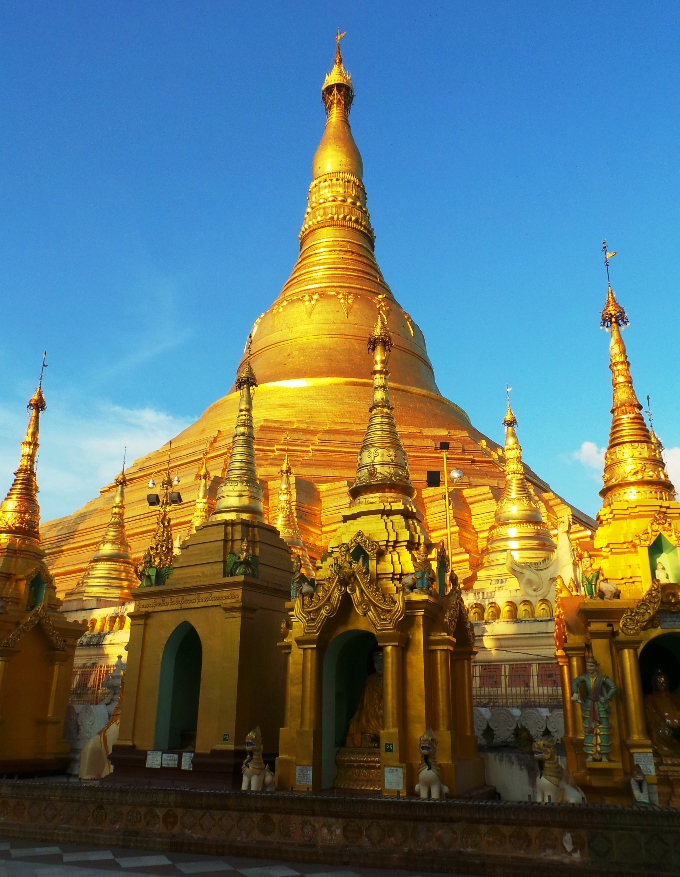
Few religious monuments in the world are as impressive as Shwedagon Pagoda, with its gigantic 99m golden stupa. The pagoda can be visited at any time during the day but early evening is best, when the sunset light has a transformative effect on the gold-encrusted stupa and the many subsidiary shrines. The pagoda is covered with hundreds of gold plates and the top of the stupa is encrusted with diamonds and rubies and other precious gems, and a 72 carat diamond at the very top. The whole compound is huge and glorious, with an astonishing array of carvings, statues, parks and gardens, ponds and devotional spaces.

Colonial buildings

Colonial buildings

Quite a number of old public buildings built in the time of the British occupation still remain although many are presently empty and are rotting away. For many visitors they are one of the major attractions of the city and it is hoped that most or all can be saved and recycled in the near future. The Yangon City Hall, next to Sule Pagoda, is one that is being used and it appears to be in reasonable condition. The old Supreme Court (1910) to the south-east is painted in red and yellow but it is looking rather sad. A short distance to the south is the famous Strand Hotel which was constructed in 1901 and was among the best hotels in Asia when it opened. Perhaps the most impressive building of all is the old Ministers’ office, which occupies a whole city block.

Kandawgyi Lake

Kandawgyi Lake

This is a very attractive artificial lake, located east of the Shwedagon Pagoda, which is surrounded by the Kandawgyi Nature Park, and the Yangon Zoological Gardens. The lake and the surrounds provide a quiet, quite beautiful environment and great photographic opportunities. There are long wooden walkways built over the lake which provide nice views. There are several lakeside restaurants serving local food at reasonable prices which are very popular with locals.

Chinatown

This is probably the busiest area of Yangon. It is centred on Latha Road in the western part of downtown but it spreads across several blocks in each direction. The shops, with their bright neon lights and garish advertising, are a seething mass of people during both daytime and evening, and restaurants abound. It is an extremely important commercial centre especially for gold, jewellery, electronics, mobile phones, consumer goods and groceries.

Chinatown

19th Street is packed with restaurants and roadside barbeque vendors selling all manner of dishes. Aging buses run on the east-west streets while pedestrians and vendors cram the north-south streets seeking and selling fruit, vegetables, fried snacks and more.

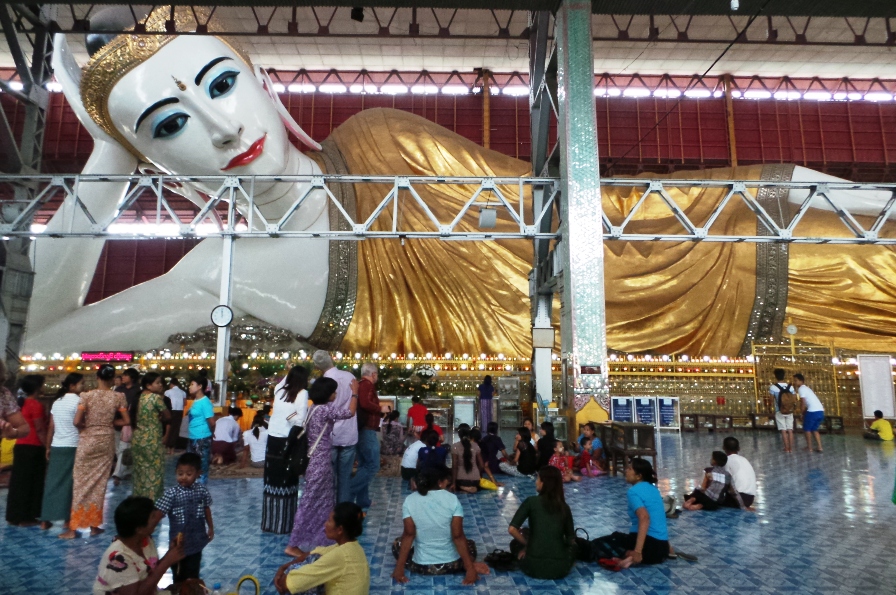
Reclining Buddha

Reclining Buddha

The 72 m reclining Buddha image in the Chaukhtatgyi Pagoda is one of the biggest reclining Buddha images in Myanmar. Originally built in 1907, it was demolished and rebuilt in the 1960s. The Buddha image is wearing a golden robe and has a white face, red lips, blue eye shadow, and red finger nails. The soles of the feet contain 108 segments in red and gold. Buddhist people burn incense sticks and offer flowers to the Buddha then pray to the shrine belonging to the day of their birth.

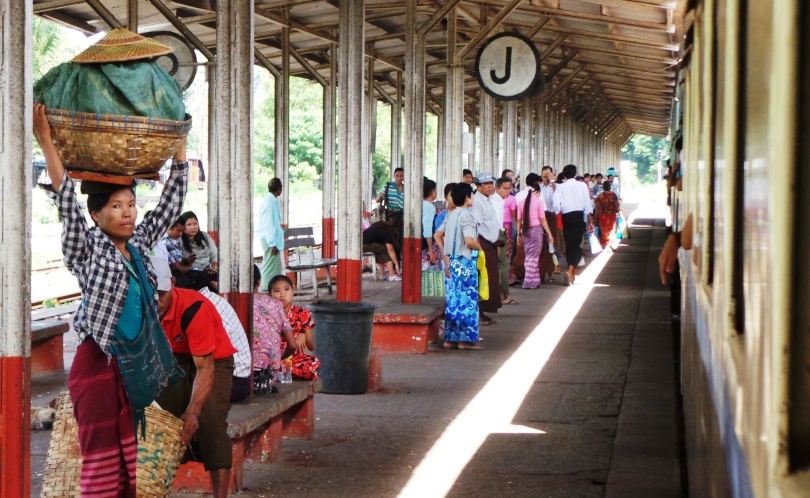
Circular railway

Circle train

There is a very slow circle train which travels around Yangon and takes about 2.5 hours to complete the trip. Trains go in both directions approximately every hour. Most have wooden seats and no air-conditioning and visitors are encouraged to use one particular carriage which is slightly more comfortable than the others. Locals are also allowed to use this car provided they have few parcels. The rest of the train becomes very crowded but this can provide an insight into local life.

Downtown streets

Street activity

The city’s street life always makes an impression on me. I find the street-side stalls, where diners tuck into bowls of steaming noodles; the ancient, overloaded, buses jostling for space at junctions with trishaws, trucks and taxis; and the open-air markets, where traders squat beside piles of fresh produce, to be quite fascinating. You can stop for refreshments in a traditional Burmese teahouse before enjoying the priceless treasures at the impressive National Museum and it can be fun to join the crowds milling around Bogyoke Aung San market or the various ferry jetties.

Len Rutledge is the author of Experience Myanmar, available as an e-book at http://www.amazon.com/dp/B00HPQHC5I